

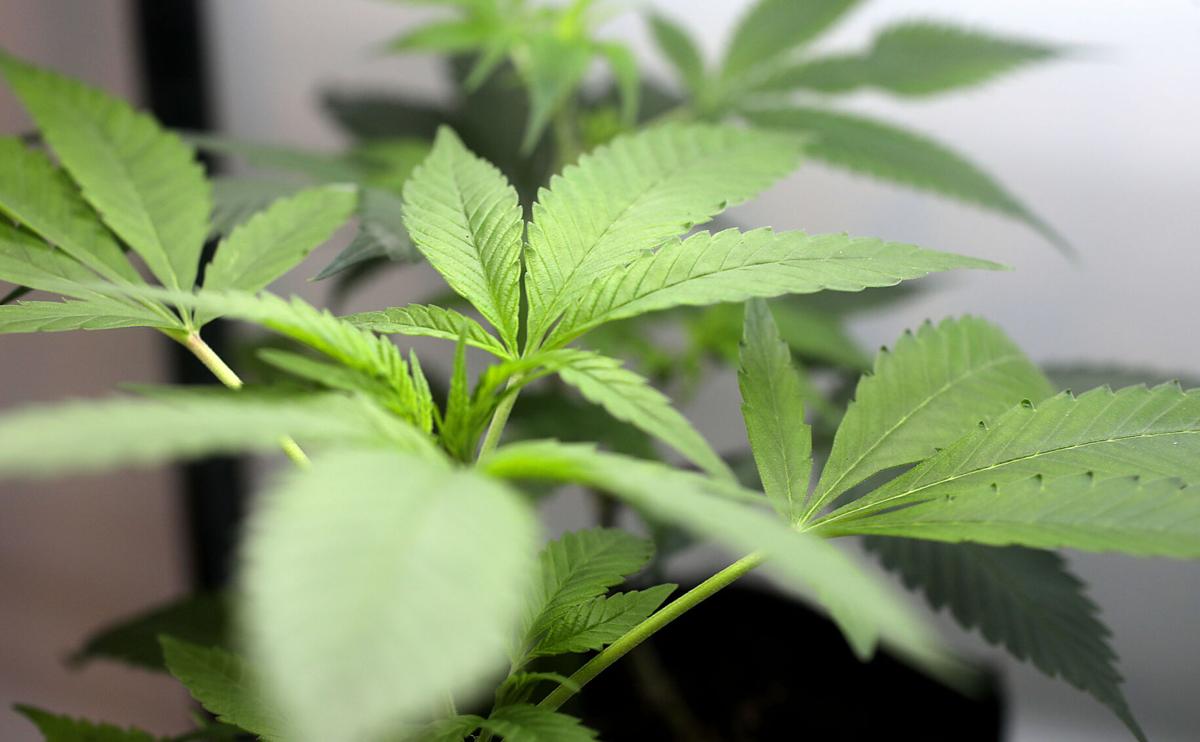
Marijuana plants at Strain Station Dispensary Wednesday, Feb. 24, 2021 in Tulsa, Okla.

LeeAnn Wiebe
I opened Apothecary Farms in Colorado in 2015, a licensed medical marijuana business and Colorado’s first extract-focused dispensary. And when Oklahoman voters approved SQ 788, we were thrilled to expand to the Sooner State, opening our doors in Beggs, Oklahoma, in 2018.
We’re proud to be one of largest employers in Beggs with over 80 team members, and our Oklahoma businesses will soon outgrow our entire Colorado operation. However, for Oklahoma’s legal marijuana program to realize its full potential, we need commonsense rules that protect patients, increase transparency, drive product quality and create a level playing field for all businesses.
To make that happen, regulators need to be able to track all legal marijuana from seed to final sale to a patient. That’s why we fully support the Oklahoma Medical Marijuana Authority’s use of a seed-to-sale system that tracks information on every legal marijuana plant and product in the state. Using seed-to-sale solves some of our biggest challenges here: supply chain transparency, ensuring products are safe and stopping the illicit market.
For example, each month we source thousands of pounds of cannabis material from dozens of local growers. To account for that, we have two full-time employees to track down all the needed information including proof of licensure, test results and batch information. This tedious process ties up our team’s time and stops quality material from getting to market. Often, when we run our own lab tests on these products, the results don’t match what we’ve purchased, and we must destroy the inventory. Ultimately, this creates more costs for companies striving to be compliant.
Implementing a statewide seed-to-sale system would solve these issues, create supply chain transparency, ensure products are safe, save businesses like ours a significant number of resources, and ultimately save Oklahoma patients’ money. And the cost to get started on any seed-to-sale system pales in comparison to some of the real issues being overlooked by many in the Oklahoma cannabis community.
Two of those overlooked issues are batch-size requirements and process validation. Right now, every 10 pounds of harvested marijuana must undergo a full-panel compliance test. That means for 100 pounds of identical product, we must complete 10 separate tests. Since each test costs around $350, Apothecary alone will spend over $700,000 this year to test the 20,000 pounds of marijuana we hope to harvest. That 10-pound threshold is an arbitrarily low limit that other states have set much higher or eliminated altogether.
Furthermore, small businesses like ours, can create consistent products that meet regulatory standards by tightening process controls. Oklahoma could adopt process validation, a method the Federal Drug Administration uses for pharmaceuticals and commercial food, to eliminate redundant product testing. Process validation uses a verified manufacturing process to produce the same result reliably within specification. If implemented, this stringent production criteria would save small businesses millions of dollars annually while protecting patient safety and making products more affordable.
So far, OMMA has done well with the tools they have been given, but there is still room for improvement as the market matures. The Legislature and OMMA should continue to take a critical look at the laws and regulations that most impact Oklahoma patients and businesses. However, they can’t do this alone. Our patient and business communities must legitimately organize and advocate to focus on policies that promote safety, transparency, and high product quality.
LeeAnn Wiebe is the CEO of Apothecary Extracts, a licensed medical marijuana business in Beggs, Oklahoma.
Featured video:
Editorial Pages Editor Wayne Greene reads the Tulsa World editorial, “After studying Epic schools for 13 months, Oklahoma’s multicounty grand jury has issue an agenda for reform….”
LeeAnn Wiebe is the CEO of Apothecary Extracts, a licensed medical marijuana business in Beggs, Oklahoma.


Recent Comments